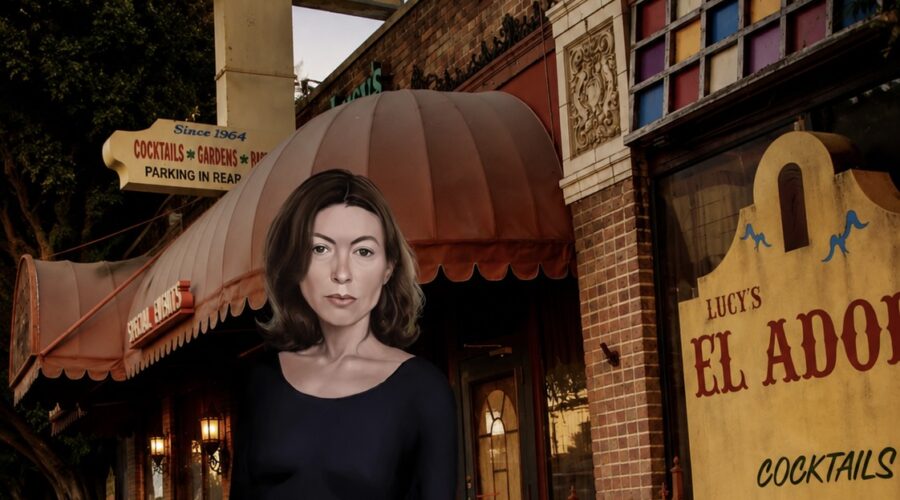
Joan Didion defined the California Dream not as a simple utopia, but as a complex, often dark paradox of rugged individualism, reinvention, and disillusionment. Welcome to the tragic end of Lucy’s El Adobe Café.
JOAN DIDION UNDERSTOOD something about California long before the rest of us did. Beneath the bougainvillea and swimming pools, beneath the canyon homes and political glamour and endless self-invention, she sensed instability. California was forever improvising itself. Reinventing itself. Selling itself. Beneath the beauty there was always the faint smell of something overheating.
In 1978, not long after I arrived in Los Angeles as part of the much-publicized effort to help save the old Los Angeles Herald Examiner under legendary editor Jim Bellows, I somehow found myself put in touch with Didion. At the time she was the intellectual patron saint of California unease, already famous for chronicling the strange emotional weather of the state. Stories had appeared about the Herald Examiner’s attempt to reinvent itself with Bellows’ imported band of New Journalists, and somebody thought we ought to meet.
I asked her to lunch.
I suggested Lucy’s El Adobe Café on Melrose Avenue.
Even then, Lucy’s was already becoming more than a restaurant. It was one of those Los Angeles crossroads where politics, movies, journalism, music, and Mexican food fused together beneath dim lighting and cold margaritas. Across from Paramount Studios, Lucy’s felt like part clubhouse, part confessional, part accidental city hall.
Didion hesitated.
She and John Gregory Dunne had retreated westward by then, Malibu and Brentwood replacing much of their earlier Hollywood orbit. She had concerns, understandable ones. I assured her I wasn’t planning to profile her or write some sly newspaper column after lunch.
“I wouldn’t do that to you,” I said.
Then I added that I understood she collected people in Los Angeles for her work, and I didn’t especially want to end up in one of those collections either.
She laughed.
It was the perfect Joan Didion response, amused and wary at the same time, two reporters gently circling each other with invisible notebooks tucked behind their backs.
We met instead at a Mexican restaurant in Westwood, one no longer there. Maybe that itself says something about Los Angeles. Mexican restaurants disappear here the way marriages and political movements do. One day they seem permanent, woven into the emotional geography of the city, and then suddenly they are gone and somebody else is selling sushi or luxury handbags where enchiladas used to be served.
Over the years I would come to know Dominick Dunne somewhat better than Joan, especially after he returned to Los Angeles and reinvented himself as the great chronicler of celebrity crime and social ambition. But Didion stayed with me because she seemed to understand earlier than almost anybody that California dreams rarely collapse dramatically. More often they simply erode. Quietly. Beneath the surface. Until one day people look around and realize the thing they thought would last forever has vanished.
Which brings me to Lucy’s El Adobe.
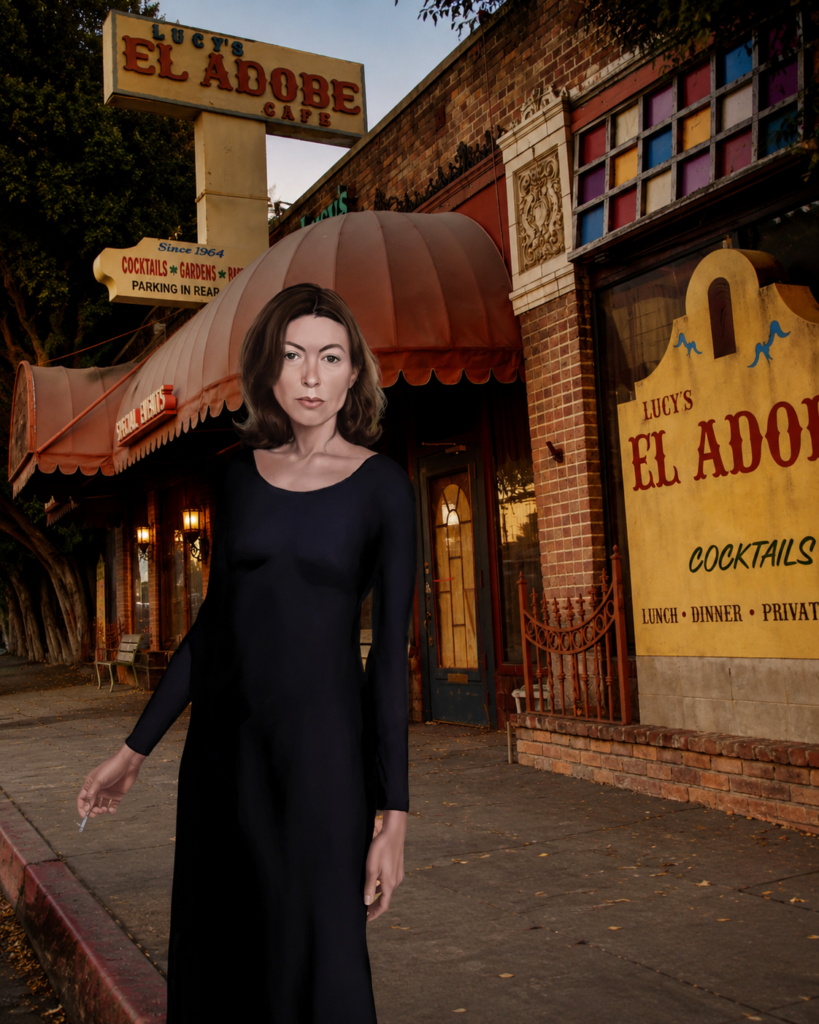
For years I suppose part of me believed Lucy’s would somehow come back, even if only as a diminished version of itself. A smaller stand. A surviving fragment. Some modest shrine to the old Los Angeles. Instead it now appears to be gone for good, and with it perhaps an entire version of California itself.
The official story is simple enough. Restaurants close. Families fight. The pandemic destroyed businesses. But the real story feels more complicated and much sadder than that.
Lucy’s was founded in 1964 by Frank and Lucy Casado, neither of whom fit the polished corporate mythology of modern Los Angeles hospitality. Frank had once delivered soda water in trucks before building the restaurant largely by instinct and force of personality. He loved telling people he built the famous bar himself. The original restaurant was little more than a narrow strip of tables running through a modest space before eventually expanding outward during the restaurant boom years of the late 1970s and early 1980s.
But what Lucy’s really sold was belonging.
Governors came there. Jerry Brown practically used it as an auxiliary office during his first rise to power. Linda Ronstadt drifted through. Members of the Eagles appeared. Political operatives, journalists, actors, studio people, lonely newcomers, ambitious young writers. The place functioned as a kind of improvised salon for the California dream machine.
And like many California dreams, it resisted institutionalizing itself.
As early as the late 1970s and early 1980s, people approached Frank Casado about expansion possibilities. Franchising. Olympic tie-ins during the buildup to the 1984 Los Angeles Olympics. Branding the famous margaritas. Satellite locations. Others around Los Angeles were turning tiny local businesses into regional empires.
Frank resisted nearly all of it.
Maybe it was stubbornness. Maybe caution. Maybe distrust. Maybe fear of scrutiny into finances or background or ownership structures. Maybe simply the belief that Lucy’s should remain Lucy’s and nothing more.
But over time, what once seemed charmingly independent began looking dangerously fragile.
When Frank died, Lucy inherited the mythology but perhaps not the infrastructure necessary to preserve it. And later, after her death, the burden passed to children who inherited not merely a restaurant but an entire collapsing emotional kingdom.
By the time the pandemic arrived in 2020, the foundation underneath the mythology had already weakened badly. Other restaurants survived through takeout windows, curbside service, improvisation. Friends of the family still insist Lucy’s could have done the same. Cars could easily have driven through surrounding lots picking up food and margaritas without customers leaving their vehicles.
Instead the restaurant closed completely.
And somewhere in the years that followed, the California dream that Lucy’s represented began quietly bleeding out.
The saddest figure in all this may have been Patty Casado.
When she finally regained control of the restaurant after long family struggles, she inherited not triumph but wreckage: legal disputes, renovation demands reportedly approaching millions of dollars, tangled property questions, pressure from every direction. Friends describe her trying desperately to save not merely a business but a family legacy and perhaps a version of herself.
One friend who had known Patty for half a century described meeting her shortly before her death. Patty arrived walking slowly, breathing hard, looking exhausted and swollen, her once-striking appearance diminished by illness and stress. Yet she was still talking about reopening the restaurant. Still fighting. Still trying to hold the old dream together with sheer willpower.
Then came the hospital.
Sepsis. Tubes. Emergency surgery. Friends sitting nearby trying to comfort someone who apparently still believed she might recover and finish the renovations.
But the dream had already reached its final call.
And now the questions drift around Los Angeles like smoke after closing time. What happened to the family fortune? What happened to Patty’s belongings, her books, her treasures, her inheritance? What happened to the restaurant itself? What happened to the California that once seemed capable of creating places like Lucy’s out of pure charisma and momentum?
Joan Didion would have understood the ending.
Because Lucy’s El Adobe was never just a restaurant. It was a California illusion people collectively agreed to believe in. A place where politics and celebrity and journalism and romance and Mexican food all blended together beneath soft light while outside, beyond the margaritas and stories and music, time quietly kept moving.
And one day the lights came on, the dream staggered toward the parking lot, and nobody really knew how to bring it back.
TONY CASTRO, the former award-winning Los Angeles columnist and author, is a writer-at-large and the national political writer for LAMonthly.org. His forthcoming biography about Marilyn’s childhood and youth, THE GIRL WHO WOULD BE MARILYN MONROE, will be published in September by Bloomsbury. He can be reached at tony@tonycastro.com.