THERE ARE MOMENTS from a reporter’s life that do not fade into memory so much as sink into the bloodstream.
Forty-four years ago this month, I was living at the Hotel Camino Real in San Salvador with a woman named Estela.
At least that is the simplest way to tell the story.
The truth is more complicated.
It was 1982, and El Salvador was on fire.
Not metaphorically. Literally.

The country was in the midst of civil war, and everywhere there were soldiers, checkpoints, machine guns, helicopters, rumors, funerals, American advisers, frightened priests, wealthy families behind walls, and young revolutionaries convinced history itself was standing at their shoulder.
I had gone there as part of a yearlong project for Hearst Newspapers, publisher of the Los Angeles Herald Examinerwhere I was the columnist. Several reporters had been dispatched throughout Central America. I was the only Spanish-speaking member of the group, which meant I often moved more freely than the others, hearing conversations directly, catching nuance, understanding jokes, insults, warnings, and the subtle shifts in tone that sometimes matter more than the words themselves.
Most of the American journalists, diplomats, intelligence people, aid workers, and wandering political pilgrims passed through the same hotel in San Salvador. If memory serves, at certain hours the lobby resembled the final act of a Graham Greene novel rewritten by somebody from NBC News.
Everybody was smoking.
Everybody claimed to know what was really happening.
Nobody really did.
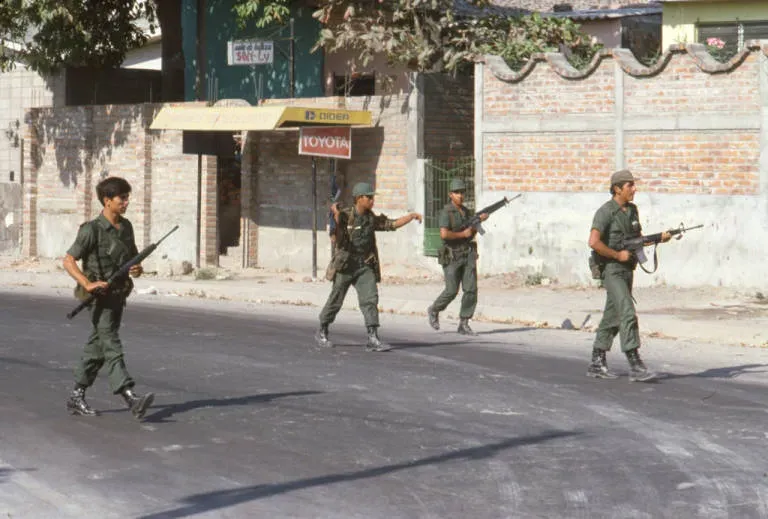 Salvadoran troops patrol a neighborhood street in San Salvador in 1982 as a Civil War raged on.
There were translators assigned to many of the visiting journalists. They came and went in a kind of quiet procession, moving between worlds with remarkable ease. Some were simply language specialists. Others clearly possessed connections and access that went well beyond translation.
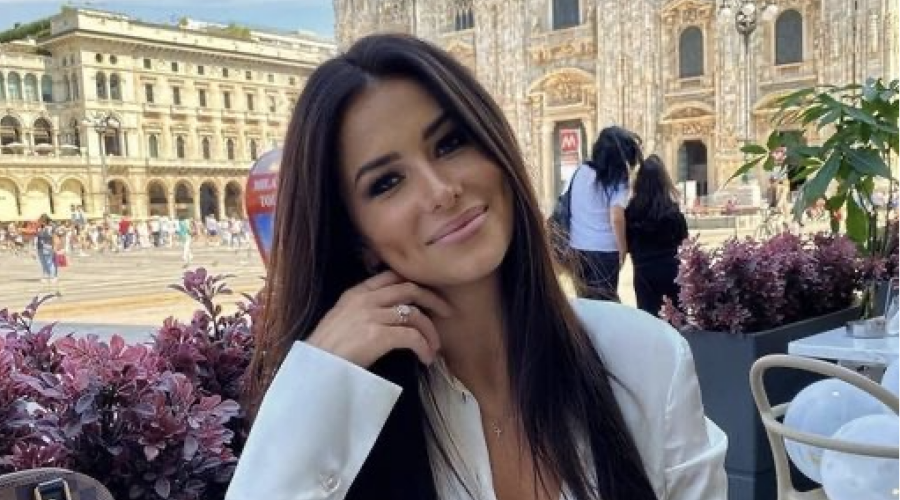
And then there was Estela.
She was different from the beginning.
Beautiful in an understated, old-world way. Brilliant. American educated at the University of San Francisco, where she had accumulated degrees and honors before returning home to El Salvador. She came from extraordinary wealth, though she carried it lightly enough that at first you could almost miss it.
Almost.
People had already explained to me the existence of “Los Catorce,” the fourteen ruling families who had long dominated the economic and political life of El Salvador. It sounded half mythical when I first heard it, like something from a Gabriel García Márquez novel.
Then I entered Estela’s world.
The mansion stood behind walls and guards. There were servants moving quietly through rooms larger than most apartments in Los Angeles. Paintings. Imported furniture. Crystal. The kind of inherited wealth that exists so comfortably with itself that it no longer needs to announce its importance.
Yet at the same time, Estela was sympathetic to the rebels.
Or at least she said she was.
And perhaps she was.
That was the thing about El Salvador in 1982. Everybody seemed divided between multiple selves.
Government officials privately criticizing the government. Revolutionaries quietly coming from wealthy families. American advisers talking democracy over drinks while death squads operated in the darkness. Priests preaching peace in villages where bodies appeared the next morning.
Even language itself felt unstable.
And translators occupied a strange and powerful position in that universe. They moved between factions, ideologies, classes, and nationalities. They were interpreters not merely of words but of realities.
Estela quickly became more than a translator.
Before long we were sharing a hotel room.
Occasionally I stayed with her family.
They had a beach house along a black sand beach that looked volcanic and ancient, as though the earth itself had once suffered a violent wound there. I can still remember the Pacific surf crashing against that dark shoreline while servants prepared drinks under umbrellas and helicopters occasionally thudded across the distant sky.
War and privilege coexisting within the same frame.
Very little in America had prepared me for that.
At times our relationship seemed almost absurdly romantic. She spoke about possibly returning to California with me someday. We talked about marriage in the vague, dangerous way people sometimes do when they are young enough to believe history bends for love.
Could she imagine being married to an American?
Could I imagine being married to a Salvadoran woman from one of the country’s ruling families?
And then there was the other layer.
The layer I did not fully acknowledge at first.
I began noticing things.
Conversations that stopped too quickly. People who seemed to know details they should not have known. Moments when Estela appeared to possess information from both government and rebel circles.
Nothing dramatic. Nothing provable.
Just enough to awaken the reporter inside me.
That may have been the beginning of the end.
Because journalism and love require opposite instincts.
A reporter notices inconsistencies. A lover overlooks them.
And somewhere along the line I began thinking too much like a reporter and not enough like a lover.
I returned briefly to California in late May because the newspaper needed help covering the California primary. I left most of my belongings behind in the hotel room we shared, fully expecting to return.
And I did.
The moment the primary ended, I boarded a flight back to San Salvador.
But something had changed.
The atmosphere felt different.
El Salvador had recently held its first election during the civil war. Some of the American press contingent had departed. Certain tensions had eased while others had deepened. Estela herself seemed altered somehow.
Less translator. More connected to the new political reality emerging around us.
I was there perhaps a week before the phone threats began.
That in itself was not unusual for journalists working in Central America at the time. Threats floated through the air there like humidity.
But there were other things.
I became convinced somebody had gone through my notebooks.
Not casually. Not out of curiosity.
Systematically.
I telephoned my friend, the Los Angeles attorney Alex Jacinto, and spoke to him carefully about my growing unease. He suggested that perhaps it was time to think seriously about coming home.
But I was still emotionally entangled.
I even told him I might marry Estela.
To say those words aloud now, forty-four years later, still startles me a little.
Because in some alternate version of history perhaps I did.
Perhaps there exists another Tony Castro somewhere who stayed in El Salvador, married the girl from the black sand beach, and spent the rest of his life navigating that dangerous, intoxicating intersection of politics, privilege, and revolution.
But instinct is one of the few things that has consistently saved reporters throughout history.
And my instincts were beginning to scream.
Then came the World Cup.
By some miracle El Salvador had qualified for the tournament, and one Sunday the entire city seemed to shut down for a televised match.
It was extraordinary.
A nation at war collectively pausing to watch soccer.
The streets emptied. The city quieted. The country inhaled.
And during that strange suspension of normal life, I packed my bags.
Quickly. Quietly.
I carried them downstairs, hired a driver, asked to be taken directly to the airport, purchased a ticket, and left.
No dramatic confrontation. No accusations. No final revelation.
Just departure.
On the flight home I wrote Estela a long letter.
I did not accuse her of anything.
Perhaps because I did not truly know anything.
Or perhaps because I did not want to destroy the memory of what we had shared by forcing it into the harsh light of certainty.
The letter simply suggested it was time for me to return home.
We spoke several times afterward by telephone. She discussed tentative plans to come to California.
Nothing ever happened.
And so Estela became one of those people who remain suspended in memory not as a completed chapter but as an unresolved atmosphere.
For years afterward, whenever I watched films like Casablanca, I understood Rick Blaine a little differently.
People often think Casablanca is fundamentally about war.
It is not.
It is about people whose private lives are interrupted and reshaped by history.
Love complicated by ideology. Romance destabilized by politics. Identity blurred by dangerous times.
That was El Salvador in 1982.
And perhaps that is why the memory still lingers after forty-four years.
Not because I am nostalgic for danger. Not because I imagine myself some romantic adventurer.
But because there are moments in life when history and intimacy collide so powerfully that they leave permanent fingerprints on the soul.
I still sometimes wonder what became of Estela.
Whether she ever married. Whether she remained in politics. Whether she survived the long aftermath of the war. Whether she ever thinks of the American reporter who suddenly disappeared during a World Cup match.
And occasionally I wonder something else.
Whether she was exactly who she said she was.
Or whether, in a country where everybody occupied multiple worlds at once, she too was navigating dangerous roles she could never fully explain.
At this age, I no longer believe every mystery requires solving.
Some are simply meant to accompany us.
Like distant music drifting across black sand at dusk.
TONY CASTRO, the former award-winning Los Angeles columnist and author, is a writer-at-large and the national political writer for LAMonthly.org. His forthcoming biography about Marilyn’s childhood and youth, THE GIRL WHO WOULD BE MARILYN MONROE, will be published in September by Bloomsbury. He can be reached at tony@tonycastro.com.