
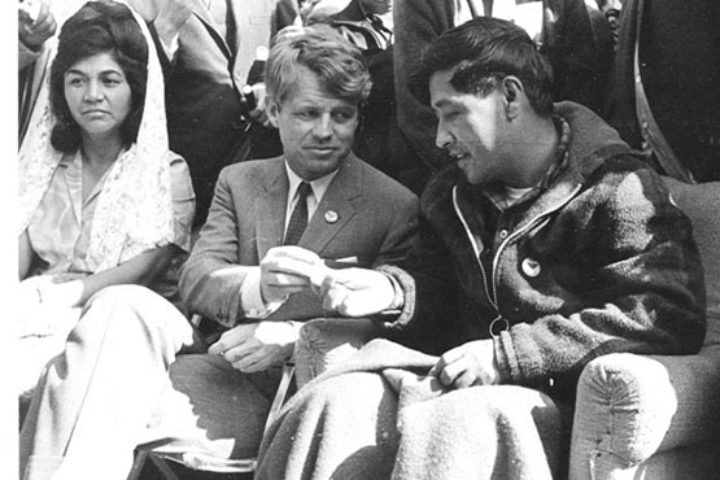
It was as if the great farm labor leader, once he walked out of the fields, was now walking on water. And that image wasn’t just misleading — it gave César Chávez the license to abuse.
THERE ARE MOMENTS IN a reporter’s life when the past doesn’t just revisit you. It sits across from you, quietly, and asks a question you never thought you would have to answer.
This is one of those moments.
For those of us who covered the farmworker movement, who wrote about César Chávez as something close to a secular saint of the American story, the revelations emerging now land with a force that is both professional and deeply personal. They are not just allegations against a man. They are a reckoning with memory itself.
The reporting now coming into public view—accounts from women who say they were abused as minors, and from Dolores Huerta herself, who has described coercion and rape during the movement’s earliest years—has shaken the foundation of a legacy that for decades felt almost beyond question.

And it leaves some of us asking, quietly and uncomfortably: What did we miss?
I wrote about César Chávez extensively during our separate careers. I profiled him in perhaps overly lavishing praise in my 1974 civil rights history, Chicano Power. I interviewed him numerous times, including at his California headquarters known as La Paz. How did I not see any of this?
Or perhaps the harder question—what did we choose not to see?
Because the truth is, the Chávez we covered was not just a labor leader. He was a symbol. He was the embodiment of sacrifice, fasting, discipline, nonviolence. He was the man who walked out of the fields of Delano and into American myth. Presidents praised him. Schools were named after him. His birthday became a day of civic reverence.
And we, the chroniclers of that movement, helped build that myth.
We wrote about the marches. The boycotts. The fasts that seemed almost biblical in their endurance. We wrote about dignity wrested from injustice, about Filipino and Mexican farmworkers standing shoulder to shoulder in a cause larger than themselves. We wrote about a movement that felt pure in its intent, even when the world around it was not.
But movements are not myths. They are made of people.
And people are never pure.
The emerging accounts suggest that, behind the public face of discipline and moral authority, there may have been a private world marked by power, silence, and harm—particularly toward young women and girls who were drawn into the orbit of that movement and its leader.
If even a fraction of what is now being reported is true, then this is not simply a footnote to history. It is a fracture.
And fractures demand that we look again.
It is easy, in hindsight, to imagine that the signs were there. That the intensity of the movement, the insularity of its inner circle, the reverence surrounding its leader—these were not just the byproducts of struggle, but also the conditions under which accountability can quietly erode.
There had long been whispers about the inner workings of the United Farm Workers. Stories of control. Of loyalty demanded and dissent discouraged. Of a movement that, like many others of its time, sometimes blurred the line between devotion and obedience.
But whispers are not evidence. And journalists, if they are to be fair, cannot write on whispers alone.
Still, there is a difference between what cannot be proven and what is never fully pursued.
Looking back now, it is fair to ask whether we—myself included—were too willing to accept the public narrative because it aligned with something we wanted to believe. That a movement born out of such profound injustice could produce a leader who was, in some essential way, incorruptible.
There is a kind of romance in social revolution. Anyone who covered the civil rights era, the Chicano movement, the antiwar protests knows it. The sense that history is bending, that something righteous is unfolding before your eyes, that you are witnessing not just events but transformation.
It is powerful. It is intoxicating.
And it can be blinding.
The danger is not that we admired the movement. It deserved admiration. The gains achieved for farmworkers were real, hard-fought, and lasting. Generations of laborers saw improvements in wages, conditions, and dignity because of that struggle.
The danger is that we may have allowed that admiration to harden into something less useful—something closer to reverence.
Reverence is not a journalist’s friend.
Because once a figure becomes larger than scrutiny, the questions begin to fade. Not because there are no questions, but because asking them feels, in some unspoken way, like betrayal.
And so the myth persists.
Until it doesn’t.
Huerta, one of the country’s most influential labor activists, responded on Wednesday to the explosive allegations against Chávez, saying he forced her into two sex encounters and that he impregnated her twice.
“I have kept this secret long enough,” she said. “My silence ends here.”
Her statement followed shortly after the New York Times published an article saying Huerta and at least two others were sexually assaulted by the late Chavez – the nation’s most revered Latino labor activist – who died in 1993 at the age of 66.
What we are seeing now is not just the unraveling of a legacy. It is the collision between two truths that have long existed uneasily side by side.
That César Chávez was a transformative figure in American labor history.
And that he may also have been capable of causing profound personal harm.
Both things can be true. History, inconveniently, often works that way.
The United Farm Workers itself has responded by stepping back from celebrations, acknowledging the seriousness of the allegations, and calling for space for those who may have been harmed to come forward.
That, too, is part of the reckoning.
Because movements, if they are to endure, must be able to outgrow the flaws of their founders.
For those of us who wrote about Chávez, who interviewed him, who walked the picket lines and listened to the stories of farmworkers who saw him as a lifeline, there is a particular kind of disquiet in this moment.
Not just because of what is being said now.
But because of what it forces us to reconsider about what we wrote then.
Were we fair? Were we thorough? Were we, in our own way, participants in shaping a narrative that was incomplete?
These are not comfortable questions. But they are necessary ones.
Journalism, at its best, is not about preserving reputations. It is about pursuing truth, even when that truth complicates the stories we have already told.
Especially then.
There is a temptation, in moments like this, to swing too far in the other direction—to reduce a life to its worst allegations, to discard the entirety of a legacy because of what we are only now beginning to understand.
That, too, would be a mistake.
Because history is not clean. It does not offer us heroes or villains in neat, separate categories. It offers us people—capable of building movements that change lives, and of committing acts that damage them.
The task now is not to rewrite the past in anger or in defense.
It is to see it more clearly.
To hold both truths in view.
And to remember that the people who were harmed—if these accounts are borne out—deserve to be heard with the same seriousness and respect that we once gave to the movement itself.
For me, and for others who covered those years, this is not an easy moment.
It is, however, an honest one.
And perhaps that is where journalism, and history, begin again.
TONY CASTRO, the former award-winning Los Angeles columnist and author, is a writer-at-large for LAMonthly.org. His forthcoming book, THE GIRL WHO WOULD BE MARILYN: An Intimate Portrait of the Young Norma Jeane, will be published later this year by Bloomsbury Publishing as a commemoration of Marilyn Monroe’s 100th birthday.



23 thoughts on “César Chávez and the Reckoning We Didn’t Expect”
Comments are closed.