
I had just been goosed by Joan Rivers who had been standing behind me. Not only had she goosed me but so hard that I suspected she had ripped my sexy lace panties. “Your gorgeous rhinestone strap stiletto sandals,” Joan said, her eyes darting down at my feet. “Are those Manolo Blahniks?”
By TONY CASTRO
LOS ANGELES, 1978
I LOOK LIKE A MILLION DOLLARS as I’m about to go on stage for my Open Mic gig at the Comedy Store on the Sunset Strip in Hollywood. There’s also an air of slutty hauteur. I’m wearing a slinky silver chainmail mini dress with a halter neckline, lowcut draped back, and side slits with hi-low hem that screams “knock me down and fuck me,” which may account for the pinch I felt on my butt. Seriously? I turned around to discover that, damn, I had just been goosed by Joan Rivers who had been standing behind me. Not only had she goosed me but so hard that I suspected she had ripped my sexy lace panties. Seriously.
“Your gorgeous rhinestone strap stiletto sandals,” Joan said, her eyes darting down at my feet. “Are those Manolo Blahniks?”
The friendly smile on her face quickly eased my nerves. “No, they’re from Fred Hayman’s,” I said, calling on a trick an actress had taught me about how best to disguise my voice. Then I quickly realized that I didn’t really want to disguise myself from Joan Rivers. So I quickly spoke normally. “But you know,” I said, “they may well be Manolo Blahniks.”
Joan was taking me in from my platinum blonde wig down to the stilettos when my male voice registered, and her mouth dropped wide-open in delightful surprise.
“Oh, my heavens,” she gushed. “Your voice just gave you away — you’re a guy! But you look so damn beautiful and so fuckingly convincing that everybody here tonight is going to look at us, and they’re going to think that I’m the drag queen! And you’re too glam to give a damn. You look smashing! Let’s talk afterwards.”
Even as I am living high on someone else’s dollar, trying to make some sense of my life and my own calamities that have brought me to California, I felt like I was in the middle of a dream, still living in my childhood back home in Waco, Texas. Maybe it’s because my mom persists in sending me care packages that began arriving at the Los Angeles Herald Examiner, even before I did. They are packed with her tasty oatmeal cookies and cinnamon and brown sugared buñuelos, so it’s no wonder the past continues its hold over me. Or perhaps it’s just her constantly reminding me of some things she wants me to do.
Call Raymond Aleman, she keeps insisting. She had once promised her comadre, Raymond’s mother, that she would watch over Raymond if something ever happened to her and her husband. And something has happened. I have barely been in Los Angeles a few days, but this is a priority with mom. It didn’t matter that the last time I had seen Raymond was on his high school graduation night in 1963, at the party that his parents, Doña Maggie and Don Francisco, hosted for their Ramoncito at their home on South 10th Street. As far as I know, it was the last time anyone saw Raymond in Waco. He didn’t leave in the middle of the night, but almost. Raymond left the next morning, boarding a Greyhound bus to Dallas, where he caught the first flight out to Los Angeles. Turns out the moment the last guest left the party, Raymond announced to his parents that he was gay, though that term was not in use then. Unfortunately, their reaction was predictable.
“You’re a homosexual — a faggot?” I think that’s the language that Raymond later told me he remembered his father using. Frank and Maggie Aleman threatened to disown their youngest son, as if that were going to magically terminate his homosexuality, and they told him he could no longer live at home. I learned about it the next evening when I came home from baseball practice. My mother was furious. At first, I thought it was at Raymond.
“Of course, I’m not angry at Raymond,” mom said. “That poor child has no choice about who he is. I am angry and disappointed with Doña Maggie. How could she be surprised that her little Ramoncito prefers boys over girls? What house has she been living in the last ten years?”
“Mom, you knew?” We had never talked about this.
“Of course, I knew,” she said. “Raymond, did everything short of announcing it on the 10 o’clock news? Everyone knew. But he is such a gentle, loving soul that nobody cares. And if they did, they knew not to say anything about him around me. He is my comadre’s son. She once asked me if your father and I would take him in, give him a home and raise him as our own, if anything were to happen to her and Don Francisco. And, of course, I said we would. And we would have. Even now.”
“Yeah, but I don’t think he’s ever coming back to Waco.”
“You’re probably right,” mom said.
So naturally, mom wanted me to check in on Raymond once I got to California. I promised that I would, though I hadn’t known him outside of our Jarabe Tapatío dancing escapade or spent any time with him in the last few years. The three years difference in our ages had given us different sets of friends and experiences, except when I had asked Raymond to return my Jarabe Tapatío favor for one of his own. Our church softball team had occasionally forfeited summer league games because we failed to put a squad on the field with a minimum of eight players to start a game. Would Raymond agree to be available for those times when we knew we we’re going to be short of players? He tried to beg off, insisting he was a horrible softball player who couldn’t hit and, worse, that he threw a baseball like a girl. Perfect, I told him. He would fit right in. We also had girls on the team, and we never had to forfeit again.
In Los Angeles, I tracked him down. He was living in Studio City in the San Fernando Valley where he was managing a non-equity theater not far from Universal Studios. We caught up at the Château Marmont where he was only too glad to meet. Fifteen years in Los Angeles, and he had never been to the Château Marmont. There we were, two South Waco kids on Sunset Boulevard. Sitting in the hotel lounge where I was becoming far too comfortable, I mentioned to Raymond that I’d had drinks at that exact table with Audrey Hepburn just a few days earlier. It was the wrong thing to say. The next hour, it seemed, was spent answering twenty questions from Ramoncito about the actress he said he wished he could have been, after Marilyn, of course. Thankfully, we were in a slightly secluded spot where we couldn’t be overheard and exposed as the starstruck movie fan fuckers we were. Raymond also wanted to know about my life since our time dancing the Jarabe Tapatío.
“Tell me about your marriage,” he said. “I heard it was on the front page of the Waco News Tribune and that you and your wife sued the school district and got a lot of money or something? What was all that about?
“Raymond,” I said, “there was no money. We didn’t shake down the school district.” This story had become more convoluted with each retelling, I was sensing. “My ex-wife’s parents were the ones who sued the school district. And not the Waco school district, but the La Vega school district over in Bellmead across the Brazos River from Waco. That school district wanted to take the valedictorian award away from her because they had some rule that prohibited married students from receiving school honors. They wanted to strip her of every honor and every office she had held while in high school: valedictorian, head cheerleader, yearbook editor, and a bunch of other stuff. Her family’s lawyer was like a pit bulldog and didn’t think twice about getting a court ordered injunction stopping La Vega High School from holding graduation for the entire graduating class of about 300 students. The La Vega school district didn’t have a leg to stand on. Federal courts have been knocking down those kinds of stupid school district rules right and left, and so the La Vega school district quickly threw in the towel. My young wife was able to graduate with full honors.”
“You’re saying ‘high school’? You married your wife when she was in high school?” Raymond couldn’t believe what he was hearing. “How old was she?”
“Sixteen when we got married,” I said.
“Sixteen! You married a girl who was sixteen? You could go to jail for that.” Raymond was almost out of his seat. “Tell me you’re just making this up to fuck with me. You are not that irresponsible. That’s something I would do. You were the most stuck-up, straightlaced person I know. You couldn’t stand up to any authority figure. Never a hair out of place. What was it one of those girls in our dance troupe was always saying about you? That you were conceited and convinced.”
“Yeah, whatever that meant,” I said. “But look, Raymond, this was no ordinary sixteen-year-old girl.”
“I’m sure no judge has ever not heard that before,” he said. I had to admit this sounded absurd.
“Raymond, I met her when I was a junior at Baylor,” I said. “I was working as a sportswriter at the Waco News Tribune, and I was covering the first La Vega football game of that season. The press box was filled with La Vega big shots for whatever reason, and I ended up covering the game from the sidelines. And that’s almost impossible to do. Thankfully, this incredibly beautiful La Vega cheerleader kept talking to me and, when she could, helping me identify the ball carriers and other players making plays on the field because you would never believe how difficult it is to keep up with a football game if you’re having to watch it on the sidelines where you have no clear view of what is happening on the field. It turned out that one of the other cheerleaders was dating a friend of mine from South Junior, and now he and I were at Baylor together. So, at halftime, he came down to the field, and we hung out with his girlfriend and the cheerleader who was helping me as I tried to cover the game. We went out to a movie that Sunday afternoon, and it was love at first sight.”
“But she was sixteen years old.”
“Raymond, do you know what Farrah Fawcett of that TV show ‘Charlie’s Angels’ looks like?”
Raymond’s eyes lit up.
“That’s what this sixteen-year-old girl looked like,” I said. “She might even have been prettier.”
“But she was still sixteen.” Raymond was stuck on the age. “So, her parents didn’t want their Farrah Fawcett-lookalike daughter going out with you because she was sixteen, and you were what 20 or 21?”
“No, Raymond, that might’ve been a whole lot easier for them to stomach,” I said. “But they weren’t opposed because of the age. The reason they didn’t want their daughter going out with me was because they didn’t want their daughter dating a Mexican American. They were racists, Raymond, utterly hard-core bigots.”
“But I still don’t understand,” he said. “You’re the least Mexican American, Mexican American kid to ever walk the hallowed ground of the state of Texas. Did they meet you first.”
“Yes, they met me,” I said. “They invited me into their home that Sunday night after our first date, and we watched television together the entire Sunday evening, eating ice cream sundaes and drinking root beer. They knew I went to Baylor. They knew I was a junior. They knew I worked full-time as a staff writer at the Waco daily newspaper. Her father plays golf, and we talked about golf a little bit. He asked me what I shot, what my handicap was, and I told him I had been on the Reicher High School golf team and that I was still close to being a scratch handicap golfer. To be honest, I thought he was impressed.”
“Yeah? Maybe you should’ve left out that you might’ve been a better golfer than her old man.” Raymond was right. I should have left that out.
But I don’t think anything I said or did was going to change how they felt about me. I had fallen in love with a girl whose parents represented an ugly bigotry I had never confronted before, nothing that I was aware of anyway. I was ready to walk away from it all, but she wanted to see me and insisted we had something special together. So, we dated secretly for a year, and we married secretly that next summer, the summer of 1968. She was a senior that fall, and we continued to “date” secretly, until a few days before her graduation. Unfortunately, she had confided in a few close friends, and one of them betrayed her. One afternoon she was called into the school principal’s office and confronted with a marriage license that someone had secured. Late that afternoon, she called to tell me that she had just broken the news to her parents. They had calmed down after their initial shock, and now they wanted to meet their new son-in-law and to take legal action against the school district.
Retelling the story was always exhausting, and we just sat silently for a while before ordering another round of drinks.
“Oh, I feel for you, and my heart breaks for you,” Raymond said. “What makes it so tragic is that your love story seems almost Shakespearean, doesn’t it? Did you have any children and how long were you together?”
“No kids. We were together from 1967 until mid-1974, and I thought we were just reaching the stage when we would start a family,” I said. “We were both so young. She was especially. And we wanted to establish some security, career wise.”
“And you wrote that book, I know, so you must’ve been on your way.” As he said this, I felt like I was on a talk show, because Raymond was so good at making you comfortable with him and just guiding the conversation along. “What went wrong?”
“Raymond, to this day, I don’t know,” I said. “One day in Houston it was just over. The next thing I know there’s lawyers. I’m on my own overnight. It felt like I had been married to a stranger, and one day, I realized that she had simply just dumped me for a middle-aged used catheter salesman.”
“Used car salesman? She left you for a middle-aged used car salesman?”
“No, Raymond, a middle-aged used catheter salesman.”
Raymond laughed so hard that he spit out his drink.
“Used catheter salesman? What are you talking about? Those medical tubes they stick in in your dick?”
“Yeah, she told me that he sells used medical equipment,” I said. “So, I thought that was an appropriate description for some shithole fucking my ex-wife.”
Raymond was in stitches. “I don’t mean to laugh at your heartbreak, and I am so sorry that happened to you. But there are times when you are just so damn funny. I hope you know that. I hope you’re using that wicked sense of humor you have. Have you ever thought of doing comedy yourself?”
“Not really,” I said. “I’ve never thought of myself as being funny, except for getting dragged into dancing the Jarabe Tapatío in drag with you. Jesus Christ. Whatever possessed us to do that, and your mom was all into it.”
“I know,” Raymond said. “She got so carried away. I think she wanted me to be a professional dancer.”
“Did you ever want to be?”
“A professional dancer? No, I like dancing just for the fun of it,” he said. “If you really wanna know, when I came out here, I thought it was a silver lining to my parents kicking me out of the house. I was here, and I thought I would try to become an actor. So I took acting lessons and went to auditions, but I soon realized it was hopeless for me. And it was not a good time to try to become an actor in Hollywood if you were homosexual and couldn’t hide it. And look at me. If I had learned to act straight, then maybe I would’ve been an actor. But that wasn’t going to happen. And I didn’t have the connections or the skills to work behind the camera. I thought for a while that maybe I could work my way into becoming an agent, but that wasn’t going to happen either. So I went to work at the Beverly Hilton Hotel, and I learned that I could be really good at dealing with tourists. I like people, and I like working with people.
“But you? You’re the one who should’ve done something with your acting. Anyone who could transform himself the way you did. Unbelievable! You fooled everyone into thinking you were a girl. And you know, don’t take this the wrong way. But you were much more attractive, beautiful even, as a girl, than as a boy. Did you know that? I know we only danced those few times. But did you ever dress up or go out as a girl after that?”
“No, not really.”
“What does that mean?”
“My senior year at Reicher…”
“Reicher? How did you wind up at Reicher? I had heard you went to University High.”
“Yeah, well, I did for a while,” I said, “and then I kind of screwed up, and I ended up graduating from Reicher like a good Catholic kid who has gotten into trouble.”
I told Raymond my sad tale of woe of having crossed a bitter old bitty teacher at University High School, which forced me to transfer to Reicher a week before the start of my senior year. I was completely out of sync there, knowing practically no one and resorting to speech and drama competitions for finding any kind of a niche at a tightly knit place where I was a stranger. I played Ebeneezer Scrooge in A Christmas Carole production during the holidays, and I also won several drama tournament medals with soliloquies from Hamlet. That led to befriending the nun who was the sponsor of the Reicher speech and drama department. She was the coolest nun I had ever been around and in the spring semester she approached me with a request from the general manager of the Waco Civic Theater, who was an advisor on the school’s theatrical productions. He had seen me performing Hamlet’s most famous soliloquys and wanted to cast me in some scenes from Hamlet to enter in an upcoming independent all boys school drama competition in Dallas.
Of course, this was something I wouldn’t even have to think twice about doing. In 1964, Richard Burton played Hamlet on Broadway directed by John Gielgud. What I would’ve given to have gone to New York to see that. Instead, I got perhaps the next best thing. A film of the production made from three live performances was shown in theaters that fall. I saw it no fewer than four times. On one of those occasions, I made a bootleg audio tape of the film. This tape is what I had used in learning the lines of four Hamlet soliloquys, as well as the way Richard Burton had performed them, Welsh accent and all. Then I had gone to a newly emigrated Welsh priest at St. Mary’s Church and asked him for additional assistance in getting the accent right. Burton had done the performance not in period costume but in black contemporary clothing, and I did the same when I performed the Hamlet soliloquys.
I was ready to do them again, I assured Sister Karen Patrice, our school’s drama sponsor. The look on her face, though, told me there was a problem. A big one it turned out. She kindly but quickly explained that the Hamlet role for this Waco Civic Theater entry had already been cast. Hamlet was going to be played by a boy from Richfield High School, and this wasn’t up for discussion. She said he was a son of a wealthy, local businessman and benefactor to the Waco Civic Theater. It was a bummer. But I could still be a good team player. Was it the role of Laertes they wanted me to play in a scene with Hamlet? Her face still hadn’t changed.
“No, it’s a more sensitive role,” Sister Karen Patrice said at last. “It’s probably the most sensitive role in Hamlet and could even be the most sensitive role that Shakespeare ever created.”
I was momentarily stumped. Then it dawned on me. Ophelia. Of course. It had to be. This was a drama competition being hosted by all-boys Jesuit High School in Dallas, and the Waco Civic Theater needed a boy for its entry who could play the role of Ophelia. That was it, wasn’t it? Sister Karen Patrice admitted that it was, but she wanted me to think about it before just declining outright. She said her friend, Henry Snyder, the theater’s general manager who was always helpful to Reicher High School, wanted to personally speak to me about it? Would I at least meet with him before deciding against doing the role?
Dear Lord, my God, if it’s not my mother or Doña Maggie that you confound me with, it’s a holy sister. How is this in any way fair? So, I met with Mr. Snyder. I don’t think he knew anything about me dancing the Jarabe Tapatío at the church jamaicas four years earlier. If he did, he didn’t say so. He simply talked to me about the history of male actors playing female roles in Greek and Shakespearean theater. It wasn’t a hard-sell he gave me, but it was just hard enough. He also promised to have a couple of actresses help me with the role of Ophelia. Those two actresses were incredibly helpful, especially in showing me how to more accurately change my voice to that of a woman’s by “speaking” from my abdomen and my diaphragm and not from my mouth and larynx which produce the tell-tell nasally sound so often coming from men attempting to disguise themselves as women. It may have been the best how-to-become-a-woman advice I ever received. As for Henry Snyder, he became a good friend for life.
“I have seen you doing the Hamlet soliloquys,” he said when he was first talking to me about playing Ophelia. “It’s obvious you understand the material, and that you can learn Ophelia’s lines quickly. The question is, how are you going to feel playing Ophelia? You’ll likely get a lot of teasing here at your school and among your friends. You know how other boys can be. Is that something you can handle?”
“It’s not something that would bother me,” I said.
“Good. There’s an upside to this,” he said. “Some of the people judging the competition, including this scene dramatic interpretation, are drama and theater people from colleges in the state. So, it’s like an audition, with maybe even scholarship considerations. I know you just received a journalism scholarship to Baylor, but this would be in drama.”
“Anyone from Trinity down in San Antonio among the judges?” I asked.
“Paul Baker’s people?”
I nodded. Baker was chair of the Trinity University drama department and formerly chair of the drama department at Baylor. I’d gone to school for a while with his youngest daughter, Sallie, and I just assumed she would be studying at Trinity next year. It didn’t really matter. I couldn’t see myself in San Antonio for the next four years. The previous week I had won the first Charles Johnson Scholarship awarded by Baylor in the name of the founding chairman of the university’s Journalism Department, to go along with a couple of foundation awards that were going to put me through college. Besides, I wanted to be a writer, not an actor, which perhaps made it easier for me to play Ophelia without feeling any pressure about succeeding.
“So, tell me that you did it and didn’t chicken out,” Raymond demanded, obviously, unable to contain his enthusiasm and approval of his childhood friend portraying Ophelia, and yet another role as a girl.
Yes, of course, I took the Ophelia role. It included the “get thee to a nunnery” scene and one other from Act III as well as two monologues of Hamlet and Ophelia that were combined to make it appear as if it were an actual scene of them together. It was a brilliant stroke of poetic license that heightened the tension between Hamlet and Ophelia, allowing the spurned Ophelia additional space to dramatize her own madness. The period dress I wore was virginal and in my mad scene I entered with disheveled hair, singing bawdy songs, and giving away my flowers, symbolically deflowering myself, and eventually drowning. In the end, we scored. My partner and I won first place in our competition, and I was named to the showcase’s all-star cast for my role as Ophelia. My partner, for his portrayal of Hamlet, got diddly squat. It was a triumph, I told Raymond, but it didn’t even seem as challenging, nor is frightening as dancing the Jarabe Tapatío.
“But don’t you miss it?” Raymond wanted to know. “The excitement? Dressing up? Being beautiful, and beautiful and sensual? You’ve got to miss it, even a little? Have you gone out in drag much? I don’t see how you could possibly stop. You looked so damn good when we danced, and I know my mom was concerned about what Pandora’s Box she might have opened for you. She was worried what if she had led you to discovering that you wanted to be a woman and how your mother would blame the two of us, mom and me.
“Mi pobre comadre, Doña Emma, me temo que le acabará dando un infarto, un ataque de corazón. Si su amado hijo decide que quiere convertirse en mujer, ella terminará culpándonos a mí y a ti, y tendrá razón. Dios nos perdone. That’s what my mother went around the house saying. Then, when we didn’t hear anything more, I guess we figured everything was going to be okay. But I know I worried what that experience was going to do to you? I know how much I wrestled with my own feelings once I was in touch with them. You know? About being gay. Especially in a place like Texas. And in Waco, for God’s sake. It can’t be any easier than wanting to cross-dress as a woman there either.”
“I’m sure it isn’t,” I said. “But it wasn’t something I was wrestling with. It wasn’t like I suddenly wanted to be a woman. I mean, dressing up in women’s clothes didn’t make me a woman. It didn’t make me want to be a woman any more than putting on football gear made me think that I was going to be a football player other than for that moment that I was in a game. You know? Dressing up as a woman, I felt different, that’s for sure. I felt vulnerable in a way I’ve never felt before, but I’m not sure why. I don’t know if that was a fear of some kind of physical violence, if I were to be discovered dressing like a woman or whether it is a fear of physical violence that is a risk for any woman. I mean, is that how I would be feeling if I were a woman? I’m not sure I have that kind of courage either, the courage to be a woman, with all the disadvantages of being a woman in a world, run by men, many of them crappy men? Raymond, it sure as hell gave me a better understanding of that kind of isolated instance in what a girl or a woman might be feeling. I suspect that takes a certain kind of courage that I can’t even begin to understand as a man, just like being gay, and I don’t think I could ever muster the courage to be either gay or to want to have a sex-change, if wanting to become a woman wasn’t something that was inherently in me to begin with.”
I’d never had this kind of conversation with anyone. The closest was maybe the time I had gone to have dinner with a psychology professor in Cambridge. When I arrived, a young woman sitting on the steps of the professor’s house walked over to admire my car. It was only when she asked if she could just sit in the car for a moment that I realized this was someone transitioning from male to female. It turned out that I was mistaken. This person had already undergone a sex-change operation. The psychologist’s son had become the psychologist’s daughter. But at dinner that night, it became apparent that the psychologist’s child remained troubled and unhappy. When my host excused himself to take a phone call, I was left alone with his daughter, and I had to ask why she was still so discontented after undergoing such a life-changing procedure that presumably she had undertaken in pursuit of happiness. She gave me a long answer, but perhaps the bottom line said it all.
“If I had to do it all over again,” she said. “I think I’d take the money and buy a Porsche instead.”
Raymond and I sat quietly drinking for a while before he told me he had an idea for something I should do as part of my introduction to Los Angeles. Had I ever tried improv? Improvisational acting? This was one of the classes offered at the theater he managed in the valley, and he said it might put me in better touch with both my body and my emotions. I confessed to Raymond that, while I appeared to be a successful writer and a new columnist in Los Angeles, I was hard up for money just then. Well, then, he had another idea: comedy writing. Raymond told me that a friend of his managed the Comedy Store on Sunset Boulevard, which offered comics and wannabe comedy writers a chance to audition their material during Open Mic sessions each week. Had I ever considered writing about my experience dancing the woman’s role in the Jarabe Tapatío? He said my recollections about dancing the jarabe as a girl, about playing Ophelia in drag, and even the brief story about the young woman with the sex-change who would trade it all for a Porsche if she had to do it again — he said my stories were hilarious and full of the one-liners that are the staple for stand-up comedy.
“I have an idea,” he said. He was just full of ideas today, wasn’t he? “But you’ve got to trust me.”
Hadn’t Raymond and I been down this road before? I listened, and soon found myself enrolled as an improv and acting student at his theater. I also signed up for a fencing class, and I took ballet. But the most significant thing I did happened two weeks later, near midnight, starting when I stepped out of a limousine that Raymond had hired for the evening. I was immediately greeted by wolf whistles — Phwwwwwhhht! Phwoooooh! — from drunken men on the Sunset Strip reacting to my arrival at the Comedy Store. Hello, beautiful, come give me a kiss. Well, if I was going to get a lurid phantasmagoria of gaping, gawking jaws, I decided to give them a twist of my derriere, which caused them to whoop, holler, and break out in wild applause and cat call whistles. Phwwwwwhhht! Phwoooooh!
I was scantily clad in that slinky chainmail mini dress. Thankfully, I still had what my mother had once shamelessly called “nalgas como Marilyn Monroe” and I was thin enough to get into something that my friend Barbara Jennings had in her closet. Raymond’s wardrobe and make-up friends from his theater helped dress, beautify, and prepare me for this Open Mic appearance. Damn, I looked so unbelievably hot, I wanted to fuck myself. But the pièce de résistance was the platinum blonde wig that was styled perfectly to recreate the late Marilyn Monroe.
All that work for something that was going to last barely longer then a round in a boxing ring. Open Mic comics usually were limited to two-minute gigs, but Raymond’s friend, Comedy Store owner Mitzi Shorr, agreed to give me four minutes at exactly 12:30 a.m. on a Tuesday, just after midnight, in exchange for a plug in the Los Angeles Herald Examiner. It took me a few minutes to get into the club where Mitzi took me back almost past the bar, near the stage, to wait to be called up. I stood there, getting my nerves under control, when I felt a tug on my butt.
Good that she did that. It took my mind off what I was about to do. Joan Rivers was already a well-known comedienne on the threshold of stardom and often dropping by the Comedy Store to hone her craft. What dedication and what an audience for my maiden rites in comedy. She seemed to love what I was wearing, at least, and I told her my clothes belonged to a girlfriend who happened to be my size. She lost it and howled with laughter.
“Oh, how I’d love to have a man like you,” she said in that gargled girly voice of hers. “A man who can pass for Marilyn and who would double my wardrobe!”
Next thing, I know, I was being introduced by name and as the new city columnist at my newspaper. Thank you, Joan Rivers. Jesus. That night I rocked on stage.
Judging from the oohs, wows, oh-my-gods, I-can’t-believes, whispers, unsettled rustling, and other interjections of surprise and shock, many in the audience were like Joan Rivers: under the impression I was a female comic, pretending to be Marilyn until I opened my mouth.
“I’m not only a guy,” I began. “I’m a new columnist for the much troubled and beleaguered Los Angeles Herald Examiner, and the afternoon I arrived a newsstand vendor at LAX told me it would take Marilyn Monroe writing for the Herald Examiner for him to start reading what he called “that piece of scab shit.” So, on behalf of the new and improved and no-longer-under-a-labor-strike Los Angeles Herald Examiner, here’s Marilyn or as close as we can come to her!
“Let me also just say that the reason I’m dressed this way is that I just came from the weekly meeting of the Milton Berle Chapter of Transvestites Anonymous. I suffer from a sexual identity crisis that began my first week in New York recently when I attended a party where the hostess asked if I was one of the Castro Convertibles, and I thought she was calling me out as someone who swung both ways. You know, asking me if I was Bisexual. Or, if I was someone born with both male and female genitalia. Turns out, she didn’t mean any of that at all. But I’m not from New York like I said. I had no idea that the Castro Convertible is just a sofa with a pull-out bed.
“Castro Convertible. What a name? I mean doesn’t Castro Convertible sound like a Castro-government Cuban spy who’s been turned into a double agent by the CIA? Or maybe we have it all wrong, and a Castro Convertible is a Havana cigar that’s both low in tar and high on socialism. Or it could be that a Castro Convertible is just an imported Cuban sportscar — that, of course, steers only to the left.”
Fortunately, I had my castanets with me from my Jarabe Tapatío days, figuring they might come in handy with hecklers and wolf whistlers. And they did. I’d hear a Phwwwwwhhht! Phwoooooh! And I’d reply: Snap!Two snaps when necessary. Snap! Snap! Which led to a rhythmic Snap! Snap! Snap! Then a beat quicker. Snap! Snap! Snap! Two short snaps. Snap! Snap! Followed by an even quicker crescendo the trails off that. Snap! Snap! Snap! Snap! Snap! Snap! Snap! Snap! Snap!
I still had almost half my time left, And I couldn’t just walk off the stage. So I broke out in the early Marilyn Monroe song that I used to sing as a child and wickedly worked the stage. A few months earlier, at the old Brattle Theatre off Harvard Square, I had finally seen the 1948 film Ladies of the Chorus in which Marilyn performed the song. And now this night I sashayed my way seductively as much as I could remember how she danced in that scene — tschu tschudoo tschu tschudoo tschu tschudoo-doo-doo — all the while imitating her breathy delivery as I sang a cappella using the castanets as accompaniment. Tschu tschudoo tschu tschudoo tschu tschudoo-doo-doo. Snap! Snap! Snap!
It was cold outside of Tiffanys
I was shivering in the storm
I walked in and asked a gentleman
Could I plea-ease keep warm
He asked me how come a baby doll
Has no comfy place to go
So I told that kindly gentleman
My tale of woe
Every baby needs a da-da-daddy
To keep her worry free
Every baby needs a da-da-daddy
But where’s the one for me…
And right there, as I sashayed my nalgas in my best Marilyn fashion I felt what must’ve been the last bare thread holding my panties together and on my waist. I felt the panties begin to slide down, and it would just be a matter of moments before my silvery underwear — what there was of any underwear — slithered down the side of one of my legs. Not that anyone there would see any sign or bulge of my manhood against my mini dress. I was safely well tucked: slipping the testicles back up into the inguinal canals and tucking the scrotum and the penis after them — thanks to the adhesive power of medical tape in the right places — so as to reveal nothing of my manhood. And the panties had been Raymond’s idea, offended as he was at the sight of medical tape in the most intimate of places. So he had insisted I wear some sexy Neiman-Marcus bridal panties, presumably, for my comedic deflowering. But now, in the back of my mind, while trying to do justice to Marilyn, I was panicking on how exactly she would have handled torn panties falling down her legs? Oh, knock me down and fuck me, world, and show me how to do this. Then, in the middle of my singing, I adlibbed my way through it. As my panties exposed themselves slithering down one of my skinny legs, causing a momentary outburst of laughter, I instinctively kicked upward with my right leg, just as the panties reached my right ankle. It was like a Can Can dance kick the young Doña Maggie might have executed, launching the panties skyward as if it had been planned. As they fell back to earth, I snatched them with my right hand, cracking my castanets as if they were a drum roll: Snap! Snap! Snap! Snap! Snap! Snap! Snap! Snap! Snap!
All the while, I continued singing and dancing, just as Marilyn would have herself.
Rich or poor I don’t care who
If he hasn’t got a million then a half will do
Every baby needs a da-da-daddy
Could my da-daddy be you
Every baby needs a da-da-daddy
With silver in his hair
Every baby needs a da-da-daddy
Who has some gold to spare
Some sweet softy who enjoys
Bringin’ home his baby little diamond toys, oh ho!
Every baby needs a da-da-daddy
Could my da-daddy be you
Every baby needs a da-da-daddy
In case she runs aground
Every baby needs a da-da-daddy
To keep her safe and sound
Yes we feel just like Red Ridin’ Hood
Cause the wolves are awful hungry in our neighborhood
Oh every baby needs a da-da-daddy
Could my da-daddy be you
Could my da-daddy be you
The applause was thunderous, as well as the laughter, followed by bravos, whistles, and shouts from both men and women, pleading for my panties. I tossed them to a pretty brunette in the front row, who had been cheering the loudest. She waved them round and round above her head as if they were the spoils of conquest, and in a sense they were.
Confession. I used to sing this song in the shower all the time. Sometimes to myself, often just humming it. I’d long ago memorized it, stored with other recollections from my youth: lines in ancient Greek to the preamble of The Odyssey, and the Hamlet soliloquys. So, remembering the lyrics may have been the easiest part of my gig that night. But the stage floor at the Comedy Store wasn’t meant for dancing, certainly not in stilettos — and my biggest success that evening may have been not falling on my face literally.
When I finished, the hecklers were silenced, or maybe just didn’t know what to say. I did get a big ovation and hugs from numerous watchers, including Mitzi, and some of the other Open Mic participants. I can’t say my bit at the Comedy Store landed me next to Johnny Carson on the “Tonight Show. It did get me an invitation to return the following week — which I did, again made up and dressed as Marilyn Monroe in a sexy white halter dress like she wore in The Seven Year Itch, and I once more announced that this Marilyn would be writing a three-times-a-week column for the Los Angeles Herald Examiner. I even passed out subscription forms for the paper and Marilyn Monroe’s Herald Examiner business cards bearing my office phone number and extension. Okay, so some of us at the Los Angeles Herald Examiner were secretly desperate. Sue me.
My Comedy Store appearance also got me a couple of drinks with Joan later that evening at Le Dome. She wanted to look at more of my work. But I got the impression she really wanted to see more of my wardrobe.
“You’re so lucky,” she said. “You have a body that’s ultrathin Saint Laurent archetype. Women would kill for that.”
“A diet of cocaine, cigarettes, and very little food,” I said.
“Don’t get me started.” Joan spoke as if from experience, and she was even a bit too familiar with drag queen slang.
“Do you get clocked much?” she asked. To get clocked was to be made as a man in drag. “I would never have made you until you spoke and made no great effort to disguise your voice like you don’t give a damn. And you shouldn’t. Be your own woman! You have half the men in here trying to hit on you.”
“It’s the bar’s dim lights,” I said.
“Oh, hell,” said Joan. “They’re not that dim! Come open for me in Vegas, and there you’ll see dim lights!
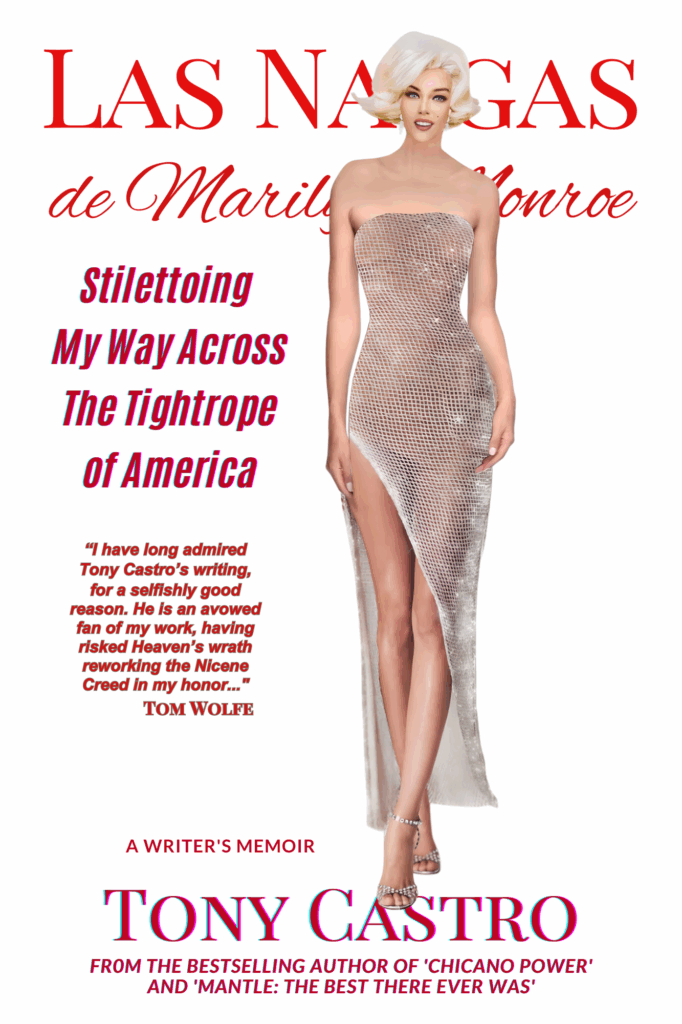
Excerpt from the forthcoming book, “Las Nalgas de Marilyn Monroe: Stilettoing My Way Across the Tightrope of America” by Tony Castro