I WAS ELEVEN YEARS OLD IN 1958, sitting in the 25th Street Theatre in Waco, Texas, waiting for Davy Crockett and the Great Keelboat Race. America was deep into the Crockett delirium. Disney had turned frontier myth into a national costume party. Boys wore coonskin caps. Parents trusted anything that came with a Disney logo. Innocence, they believed, was insured.
I was dressed for the occasion. My coonskin cap wasn’t some cheap dime-store job. It was a near-perfect replica of the one worn by Fess Parker, purchased in Dallas and therefore imbued with higher authority. My mother had sewn me a fringed suede top so I could look like a pint-sized frontiersman. I was ready for history as Disney intended it.
Then the coming attractions rolled.
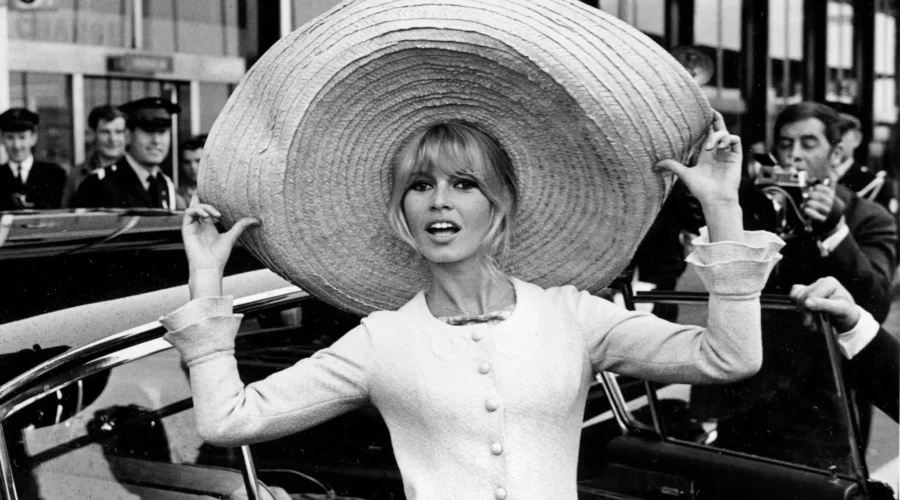
That’s when Brigitte Bardot entered my life.

She was in a trailer for a French film called And God Created Woman. Even the title alone felt like it should have required parental approval. God’s name wasn’t supposed to show up in a movie theater unless it was being spoken by a prophet, Charleton Heston or engraved on stone.
I don’t remember exactly how the trailer began, but I remember how it felt: suggestive, breathy, alarming. There was a blonde woman who seemed to sigh a lot. There were sounds that suggested something was happening that was not covered in the Baltimore Catechism. And there was the unmistakable sensation—new to me—that something important was occurring and I was both fascinated and doomed.
My jaw dropped.
My father, who normally sat through movies as still as a pew, suddenly leaned forward and stood halfway up, blocking the screen with his body like a man trying to shield his family from an eclipse. He asked loudly if we needed more popcorn or soda.
We did not need popcorn. We had barely touched the popcorn. But this was not about popcorn. This was about containment.
The trailer passed. Davy Crockett returned. I watched. I cheered. I pretended my mind was on keelboats. It was not.
The next morning after Mass, I asked my uncle Pancho—who was in his late teens and therefore knew everything—if he had ever heard of an actress named “Bridget something.” He shushed me immediately, which told me all I needed to know. This was forbidden knowledge.
A couple of days later, Pancho picked me up after school in his Wolfe Wholesale Florist delivery van, a vehicle that already felt vaguely illicit. We went for burgers and Cokes at a stand at The Circle off LaSalle Avenue. Without a word, he handed me a magazine opened to a full-page photo of Brigitte Bardot. On the next page, she was naked.
“Can I keep this?” I asked.
“Absolutely not,” Pancho said. “Your mother would find out.”
“How?” I asked.
“She finds out everything.”
This remains the truest statement ever made.
So I did what any resourceful eleven-year-old boy would do: I memorized her.
Some mornings later, I woke up early under circumstances that were confusing, alarming, and impossible to explain. I had no idea what had happened. I hadn’t even discovered masturbation yet. I was a sexual innocent in every conceivable sense.
Pancho explained it—sort of.
“Is it a sin?” I asked.
He did not answer. Which, in Catholic-boy logic, meant yes.
That Saturday, I went to confession and told the priest everything. The movie trailer. The actress. The magazine. The memorizing. The dream. He asked if I had did something. I thought he said “for an occasion.” It took years to realize he meant fornication.
My penance doubled.
Years passed. I grew older. Magazines came and went—Playboy, Penthouse, a few French imports acquired with great effort and secrecy. But Brigitte Bardot stayed. Through moves, college, storage boxes, and bedroom searches conducted by my mother with the efficiency of a federal agency, she survived.
She remains with me, stashed in a safe plastic box along side a coonskin cap.
I was saddened to learn of Brigitte Bardot’s passing today. Of course, in a broader sense, she didn’t die.
But something else did. An innocence. A certainty. And maybe the belief that the world would always remain neatly divided between Disney heroes and forbidden trailers.
She remains in my private pantheon, though, alongside Mickey Mantle, Marilyn Monroe, Sandy Koufax, and the great love of my life. Proof that God creates many kinds of miracles—some in coonskin caps, some in pinstripes, and some barefoot on a French beach.
And if I still offer a quiet prayer of thanks for the women who stirred us, inspired us, and confused us beautifully—well, I suspect God understands.
After all, He created them.
And He knew exactly what He was doing.
TONY CASTRO, the former award-winning Los Angeles columnist and author, is a writer-at-large and the national political writer for LAMonthly.org. He is the author of nine books, including his new debut novel, THE BOOK OF MARILYN. He can be reached at tony@tonycastro.com.