
The Brits think they sound better than Americans, and the French believe none of their farts stink. But does the Academy of Motion Pictures and their Oscars have to go along with such nonsense?
I have been a professional journalist since the age of fourteen. I say that as if I were working in the oldest profession in the world. For me, it has been.
The middle-aged assistant city editor who hired me back then—a redhead with a Lucille Ball look—had the prerequisite softness for “Latins,” as she called us. She mistook me for a Baylor undergraduate, not looking much past the three-piece suit I was wearing and the fact that, as she put it, I was a dead ringer for the swarthy bullfighter Romero from The Sun Also Rises, the 1957 film that had apparently stuck in her head.
All that’s to say, I’ve been writing about Mexicans, Mexican Americans, Latinos, and “Latins” for longer than I sometimes care to admit—not to mention Mexico, drugs, drug lords, undocumented immigrants, drag queens, and transgender women (back when they were simply called transsexuals).

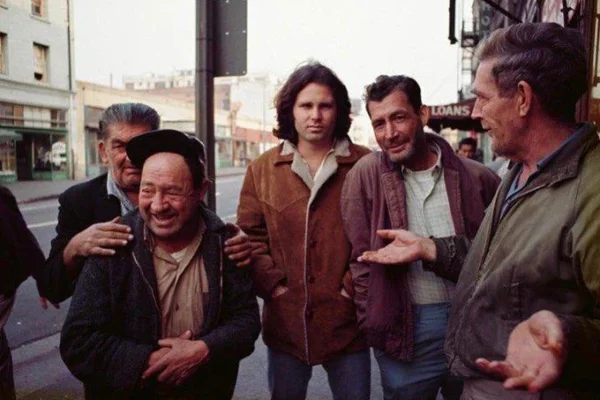
I once told that story to Bob Evans over tequila shots, and he said he was just glad somebody had gotten work from his acting.
Evans, of course, left acting and went into producing, where he was responsible for a lot of good, bad, and mediocre films. I don’t know what he would say about Emilia Pérez, the French-produced, French-made film about drug lords, transgenders, and Mexico—starring mostly Americans, filmed in France, using make-believe Mexican backgrounds and what appear to be French extras. All done with the seriousness of a musical.
“Does the drug lord murder the transgender?” Bob would have asked. “And is the music by mariachis or Nine Inch Nails?”
How could I ever tell Bob it’s not that kind of film? That would be like saying The Godfather had cast Talia Shire as the mob boss Doña Michaela Corleone.
Late last year, I tried watching Emilia Pérez as soon as it was available to stream. It felt like watching a root canal. I did not recognize the Mexico in the film and the cartel life depicted on screen seemed straight out of bad TV novela at best. The picture struck me as juvenile—maybe something Zoe Saldaña and Selena Gomez agreed to do for a young relative’s film school graduate project.
But then today is not the world of The Godfather or even the less-laudatory Godfather III. And it is not the Academy of Motion Pictures and the Oscars of that day either. Often, you get the films that reflect the quirks of the era in which you live, and you just smile cordially and say, “Sure, next.”
But when a film like Emilia Pérez gets 13 Oscar nominations, the Rip Van Winkle in you jolts awake, asking, How? What the hell is going on? If this film has 13 Oscar nominations, who’s the president of the United States?
Yeah. It’s that world we’re living in.
Maybe we need Will Smith back at the Oscars—maybe even hosting—and slapping some sense into members of The Academy. You can’t condone the violence, but you can’t excuse the idiocy either.
For those of you who missed it—and based on box office numbers, that’s most of you—Emilia Pérez is a “tongue-in-cheek” musical thriller about a cartel boss who undergoes gender reassignment surgery and starts a new life as a woman. If that sounds like a fever dream conjured up by an art-school student who just discovered irony, well, you’re not wrong. But somehow, this fever dream got greenlit, filmed, and, in a plot twist no one saw coming, showered with Oscar nominations like it was Schindler’s List.
Let’s start with the elephant—or should I say, the very confused alpaca—in the room: What exactly is Hollywood celebrating here? The film? The representation? The sheer audacity?
The Academy has spent the last decade frantically polishing its progressive credentials, which makes the fact that this film—a deeply unserious take on a very serious topic—has been knighted as a landmark achievement in cinema all the more baffling.
Mexicans, for one, are not amused. It turns out that when you take a real, devastating issue—cartel violence—and turn it into a flamboyant, high-camp musical, people don’t react well. Who knew? Imagine a Broadway-style romp about the opioid crisis or a toe-tapping, jazz-handed celebration of human trafficking.
Fun, right?
That’s essentially what we’re dealing with here, except with more sequins and an air of faux-intellectual wokeness. Emilia Pérez wants to have its satire and eat it too, but it ends up looking like a parody of itself—one of those projects so “brave” and “bold” that it circles all the way back to offensive.
And then there’s the matter of the Best Actress nominee, whose Twitter history came back to haunt her like a vengeful ghost of questionable tweets past. A Canadian journalist unearthed a backlog of posts—allegedly including some wildly racist gems—and she promptly started deleting them like Nixon with the Watergate tapes.
Hollywood, always eager to balance its guilt with performative wokeness, now finds itself in the awkward position of championing a film about identity and inclusion while its star fumbles through an apology tour that makes an oil spill cleanup look efficient.
But let’s be clear: This isn’t just about one actress’s social media implosion. The Emilia Pérez debacle is a perfect microcosm of the Academy’s desperation to appear progressive while being hilariously out of touch. After years of #OscarsSoWhite, the industry has swung so hard in the other direction that it’s nominating films not because they’re good, but because they tick the right boxes on a checklist nobody actually respects.
Take, for example, the fact that this film—this bizarre, self-congratulatory fever dream—has more Oscar nominations than Oppenheimer. Oppenheimer! A movie about the creation of the atomic bomb, directed by Christopher Nolan, featuring a cast that could act circles around anyone involved in Emilia Pérez.
But sure, let’s go ahead and pretend that a cartel leader breaking into song about their existential crisis is the true cinematic achievement of the year.
This is not to say that progressive storytelling doesn’t have a place in Hollywood. Of course it does. But progress is not “make a bizarre, wildly insensitive movie and nominate it into oblivion.” Progress is telling meaningful, well-crafted, and, dare I say, respectful stories about marginalized communities. Progress is not whatever Emilia Pérez is—a film that looks at Mexico’s struggle with cartel violence and thinks, You know what this needs? Jazz hands!
If we needed further proof that the Academy has lost the plot, here it is. This year’s Oscars are shaping up to be a stunning exercise in cinematic absurdity, where genuine artistic merit is being outshone by Hollywood’s desperate attempt to pat itself on the back.
So congratulations, Emilia Pérez. You may not have won the hearts of audiences or the respect of actual Mexicans, but you’ve certainly cemented your place in history. Not as a great film, mind you, but as one of the most bewildering Oscar darlings of all time.
Now, if you’ll excuse me, I need another tequila shot.
TONY CASTRO, the former award-winning Los Angeles columnist and author, is a writer-at-large and the national political writer for LAMonthly.org. He is the author of nine books, including his new debut novel, THE BOOK OF MARILYN. He can be reached at tony@tonycastro.com.
shot.